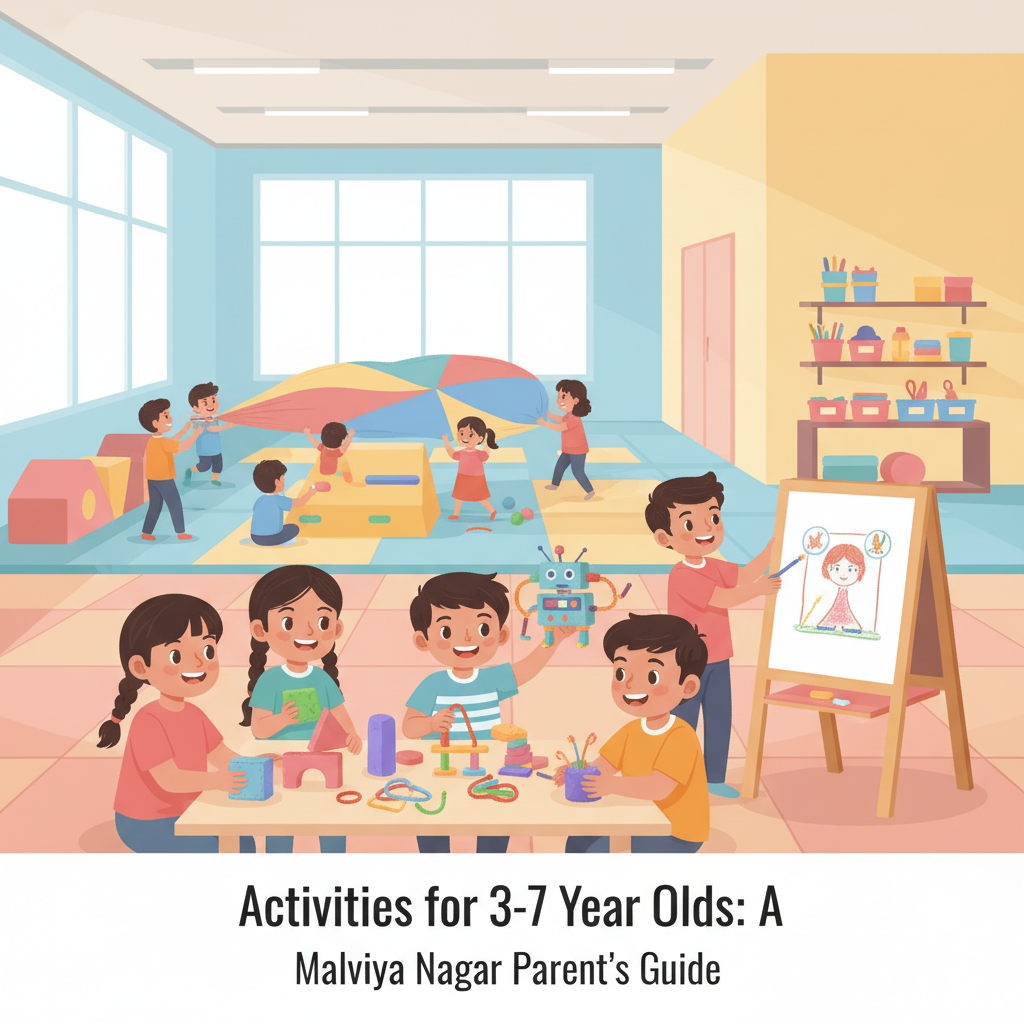
Activities for 3-7 Year Olds: A Malviya Nagar Parent's Guide
Discover age-appropriate activities for 3-7 year olds in Malviya Nagar, Jaipur, focusing on motor skills, social development, and balancing play.
By Champions Studio Team · Wed May 06 2026
Key Takeaways
- For 3-7 year olds, focus on activities that develop both fine and gross motor skills, encourage creativity, and foster social interaction.
- Balance structured classes with ample free play to support holistic development.
- Consider your child's temperament and interests when choosing activities; one size doesn't fit all.
- Look for programs that prioritize exploration, learning through play, and positive reinforcement.
- Remember that the best activity is often the one your child genuinely enjoys and looks forward to.
As your little one navigates the exciting years between three and seven, a world of new skills, discoveries, and friendships opens up. For parents in Malviya Nagar, Jaipur, figuring out the 'right' activities can sometimes feel like a puzzle. You want to nurture their development, spark their curiosity, and help them burn off that boundless energy, all while balancing schedules and budgets. It's a common challenge, and you're not alone in wondering how to best support these formative years.
This period is crucial for developing foundational motor skills, social-emotional intelligence, and early cognitive abilities. Children aren't just learning to walk and talk; they're learning to interact, problem-solve, and express themselves. The activities you choose can significantly shape these developmental pathways, offering opportunities for growth that extend far beyond the classroom.
Let's explore what activities genuinely benefit children in this age group, focusing on their unique developmental needs and how to make informed choices that truly serve your family.
Understanding Your Child's Developmental Milestones (Ages 3-7)
Before diving into specific activities, it's helpful to understand what's happening developmentally. This age range is a period of rapid growth across all domains:
- Gross Motor Skills (large muscle movements): Running, jumping, hopping, climbing, throwing, catching, balancing. These become more refined and coordinated.
- Fine Motor Skills (small muscle movements): Holding crayons/pencils, cutting with scissors, building with small blocks, manipulating buttons/zippers, drawing, writing early letters.
- Cognitive Development: Developing memory, attention span, problem-solving skills, early literacy (recognizing letters, sounds) and numeracy (counting, simple addition), imaginative play.
- Social-Emotional Development: Learning to share, take turns, understand emotions, resolve conflicts, make friends, develop empathy, follow rules, and build self-esteem.
- Language Development: Expanding vocabulary, forming more complex sentences, telling stories, understanding instructions.
The best activities for this age group will naturally support several of these areas simultaneously, offering a holistic approach to development.
| Age Range | Key Developmental Focus | Example Activities |
|---|---|---|
| 3-4 Years | Gross & Fine Motor refinement, Imaginative Play, Early Socialisation | Pre-school playgroups, art classes (finger painting), simple sports (kicking a ball), storytelling, building blocks |
| 4-5 Years | Coordination, Pre-reading/Writing, Cooperative Play, Following Instructions | Dance, swimming, early sports programs, structured art, 'Little Makers' style creative classes, dramatic play |
| 5-7 Years | Skill Specialization, Problem Solving, Teamwork, Independence, Focus | Badminton, Chess, Gymnastics, Music lessons, more complex art projects, science clubs, structured team sports |
Balancing Structured Classes with Essential Free Play
Parents in Malviya Nagar often wonder how many classes are 'too many'. It's a delicate balance. Structured activities offer specific skill development, discipline, and social interaction. However, free play is equally, if not more, vital.
"Free play isn't just fun; it's how children learn about themselves, others, and the world around them. It fosters creativity, problem-solving, and resilience – skills that no structured class can fully replicate."
Child Development ExpertDuring free play, children direct their own learning. They invent games, negotiate rules, explore ideas without adult intervention, and practice self-regulation. Aim for a mix: perhaps 1-3 structured activities per week, leaving plenty of time for unstructured play at home, in a park, or with friends.
Choosing Activities: What to Look For and What to Consider
When evaluating options, whether it's a new art class near Jawahar Nagar or a sports program in Durgapura, keep these points in mind:
- Age Appropriateness: Does the program truly cater to your child's developmental stage? A class for 6-year-olds might be too advanced for a 4-year-old, even if they allow younger participants.
- Child's Interest: What does your child gravitate towards? Do they love to move? To draw? To build? Following their lead increases engagement and enjoyment.
- Qualified Instructors: Look for teachers who understand child development, are patient, encouraging, and know how to manage a group of young children effectively. Ask about their experience with this age group specifically.
- Class Size: Smaller class sizes often mean more individualized attention, which can be particularly beneficial for younger children.
- Focus on Process, Not Just Product: Especially for creative activities, the joy of creating and expressing should be prioritized over achieving a perfect end product.
- Trial Classes: Many places offer a trial class, which is an excellent way to see if your child enjoys the activity and if the environment feels right.
- Logistics: Consider travel time, schedule fit, and costs. A fantastic class that causes daily logistical nightmares might not be worth the stress.
Activity Ideas for 3-7 Year Olds in Jaipur
Creative & Expressive Arts
- Art Classes: For 3-4 year olds, think process-oriented art – finger painting, large brushes, playdough, simple collages. As they get older (5-7), they can explore drawing, watercolors, clay modeling, and more specific crafts. These develop fine motor skills, creativity, and self-expression.
- Music & Movement: Group music classes with singing, dancing, and playing simple instruments are wonderful for rhythm, coordination, and auditory development. Dance classes (like ballet, freestyle) can also enhance gross motor skills and confidence.
- Dramatic Play/Storytelling: Look for programs that encourage imaginative play, puppet shows, or simple acting. These boost language, social skills, and emotional intelligence.
A common question from Jaipur families is how to introduce creativity. Programs like 'Little Makers' (which Champions Studio offers) are great for this age group, as they focus on hands-on exploration and imaginative building, allowing children to experiment with different materials and ideas in a supportive environment. This kind of program naturally supports both fine motor skill development and problem-solving.
Physical Activities & Sports
- Swimming: A life skill and a fantastic full-body workout. Many pools in Jaipur offer parent-and-tot classes for younger children and beginner lessons for 4-7 year olds.
- Gymnastics: Excellent for developing gross motor skills, flexibility, balance, and coordination. It also teaches discipline and body awareness.
- Skating: Roller skating or inline skating can be a fun way to improve balance and coordination, often suitable from around 4-5 years old with proper safety gear.
- Ball Sports (Soccer, Basketball, Badminton, Pickle Ball): Introduce simplified versions of these sports. The focus should be on fun, basic skills (kicking, throwing, catching), teamwork, and following simple rules, rather than competitive play. Badminton, for example, is great for hand-eye coordination and can be adapted for younger players.
Cognitive & Focus-Based Activities
- Chess: For children aged 5+, chess can be a brilliant way to develop critical thinking, problem-solving, strategic planning, and focus. It's a quiet activity that yields powerful cognitive benefits.
- Study Zone / Reading Clubs: While not a 'class' in the traditional sense, providing a dedicated space or joining a reading club can foster a love for books and support early literacy skills. For parents in Malviya Nagar, finding quiet, encouraging environments for reading can be a boon.
Parenting Challenges: Time, Money, and Your Child's Resistance
Let's be honest, parenting is full of logistical puzzles. Commuting from Pratap Nagar or Tonk Road to a class can take time, and quality activities often come with a cost. Your child might also resist a new activity, even one you think they'll love. Here's how to navigate these common hurdles:
- Time Management: Group activities geographically if possible. Prioritize what's most important based on your child's needs and interests. It's okay to say no to some things.
- Budgeting: Look for community programs, trial classes, or multi-activity packages that might offer better value. Sometimes, investing in one or two high-quality activities is better than several mediocre ones.
- Child's Resistance: Give it time. A new environment can be intimidating. Offer encouragement, but don't force it indefinitely. If resistance persists after a few sessions, it might not be the right fit. Talk to your child and the instructor. Sometimes, a different activity or a break is needed.
✅ Your Pre-Enrolment Checklist
- Observe your child: What do they naturally enjoy doing at home?
- Research options: Look into age ranges, instructor qualifications, and facility safety.
- Check testimonials: What do other parents say about the program and instructors?
- Consider logistics: Does it fit your family's schedule and budget?
- Ask about trial classes: Is there an opportunity for your child to try it out?
- Discuss with your child: Involve them in the decision-making process (for older children).
Finding the Right Fit in Malviya Nagar
Parents in Malviya Nagar often look for diverse, high-quality options for their children. While there are many choices, it's about finding a place that aligns with your values and your child's needs. For example, Champions Studio, already a trusted name in C-Scheme, is opening a new club in Malviya Nagar. They offer a wide range of activities like Study Zone, Fitness, Swimming, Skating, Music, Basketball, Painting, Pickle Ball, Dance, Soccer, Gymnastics, Badminton, and Chess. Their multi-activity packages (e.g., Deluxe for 6 activities or Premium for 4 activities) can be a great way to explore various interests and provide a holistic developmental experience under one roof.
For instance, a child might enjoy Gymnastics for gross motor development, Little Makers for creativity, and Chess for cognitive skills – all offered in a structured, supportive environment. This can simplify logistics for busy parents, especially if you're commuting from nearby areas like Durgapura or Pratap Nagar.
Frequently Asked Questions by Jaipur Parents
- What's the ideal number of activities for a 5-year-old?
For a 5-year-old, 1-2 structured activities per week is often ideal, leaving plenty of time for free play, family time, and rest. Some children thrive with 3, but always prioritize their well-being over a packed schedule. - How do I know if an activity is too much for my child?
Look for signs of stress, fatigue, irritability, or disinterest. If your child consistently dreads going, complains of being tired, or their behavior changes negatively at home, it might be time to reassess. - My child is shy; what activities can help them socialize?
Group activities that are interest-based (like art, music, or a playgroup) can be less intimidating than competitive sports. Look for programs with a strong emphasis on cooperative play and positive social interaction, where the instructor actively facilitates friendships. - Are online classes effective for this age group?
While some online classes can supplement learning, young children thrive on hands-on, in-person interaction. For 3-7 year olds, in-person activities are generally more beneficial for motor skill development, social skills, and attention span. Screen time should be limited. - How important is it for my child to 'excel' at an activity?
For 3-7 year olds, the focus should be on participation, enjoyment, skill development, and building confidence, not on excelling or winning. The goal is to foster a love for learning and movement. - What's the difference between a playgroup and a more structured activity for a 3-year-old?
A playgroup primarily focuses on free play, social interaction, and basic routines. Structured activities (like a dance or art class) have specific learning objectives, a more defined curriculum, and an instructor guiding the process. Both are valuable for a 3-year-old.
Making decisions about your child's activities can feel overwhelming, but by understanding their developmental needs and prioritizing their interests and well-being, you can make choices that truly enrich their lives. Remember, the goal isn't to create a prodigy, but to foster a happy, healthy, and curious child.
If you're in Malviya Nagar and looking for a new, comprehensive option that caters to a wide range of interests for this age group, you can register interest for Champions Studio's new Malviya Nagar club to learn more about their offerings.